Self-organised phase waves
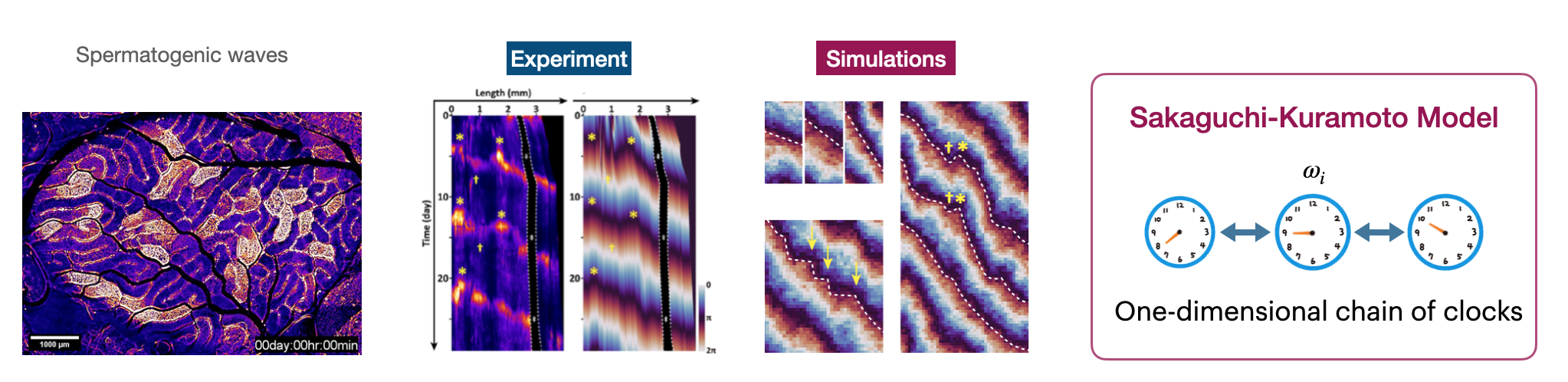
In mouse spermatogenesis, the sperm cells differentiate and mature over a long time (8.6 days). But from the mouse’s point of view, the animal would like to have sperm cells available at all times. We found that the sperm production happens in waves. What are the origin of these waves?
In the epithelium of mouse seminiferous tubules, the production of mature sperm from undifferentiated stem cells occurs in a periodic fashion, known as the “seminiferous cycle”. During such a cycle, Sertoli cells change their function in accordance with the differentiation of germ cells under the regulation of retinoic acid (RA) signalling.
In addition, the intensity of RA signalling has been observed to exhibit travelling phase waves along the length of the seminiferous tubules. Yet, the physical base of the phase wave is not understood. In this work, we construct a time-delayed model for the local cyclic behaviour, incorporating the feedback mechanisms between the RA concentration and germ line differentiation. Having established that the local model gives rise to sustained cycles, we propose a Kuramoto-type minimal model for the spatio-temporal phase profile and show that phase wave is a natural consequence of the model.