Right now this is a collection of my postdoc and PhD projects, which gives a flavour of what the group will do. If you have any questions/ideas/comments/random thoughts concerning any of my projects, please reach out!
Mechanics of non-canonical cell divisions
Holoblastic division is the textbook cytokinesis: a contractile ring is formed at the equator, which then constricts like a rubber band. In early stages of zebrafish embryo development (and many other fish, reptile and birds), meroblastic or partial division happens instead, where a contractile cable extends from the animal pole to the margin as it cuts the cell in halves. How is meroblastic cleavage achieved?
Read more →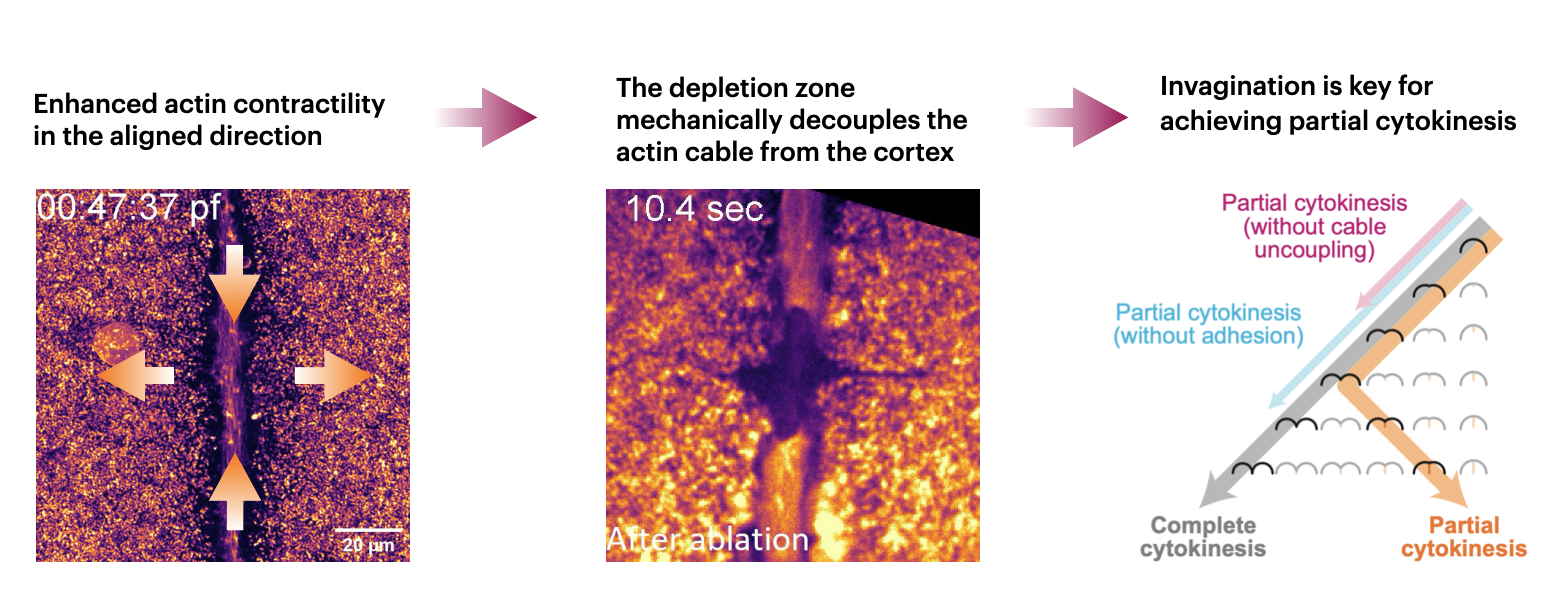
Mitotic waves
The timing of early embryonic cell divisions organises into travelling “mitotic waves” that originates at the top of the embryo ambryo and propagages towards the yolk. Is this regulated top-down or self-organised? Some back-of-envolope calculations and perturbation experiments would tell us the answer.
Read more →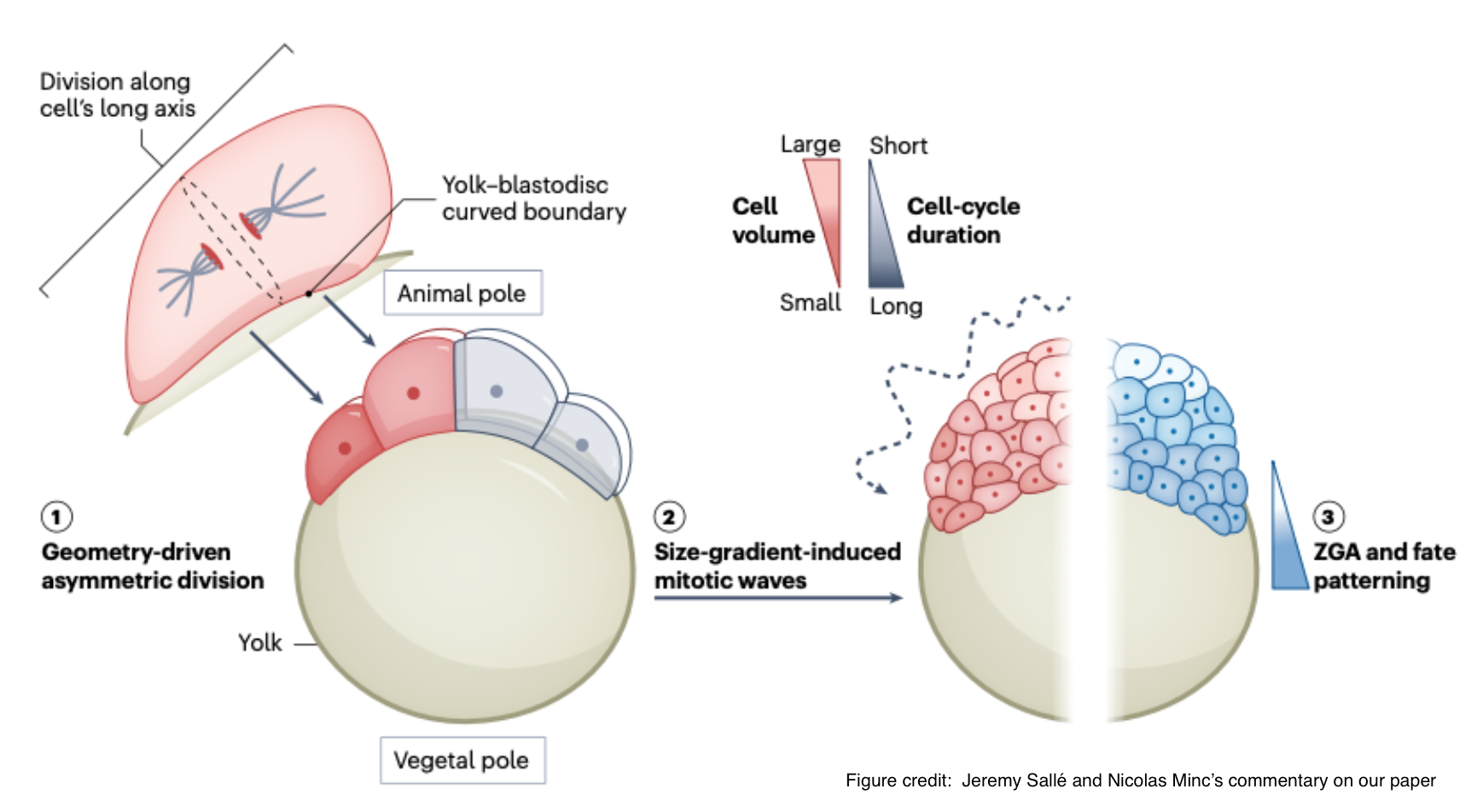
Active assembly
Beams assembled from active colloids do a lot of wacky stuff. Clamped beams seem to oscillate stochastically; free beams spin around while randomly reversing directions. Can all these by explained by one simple theory? (The answer is yes)
Read more →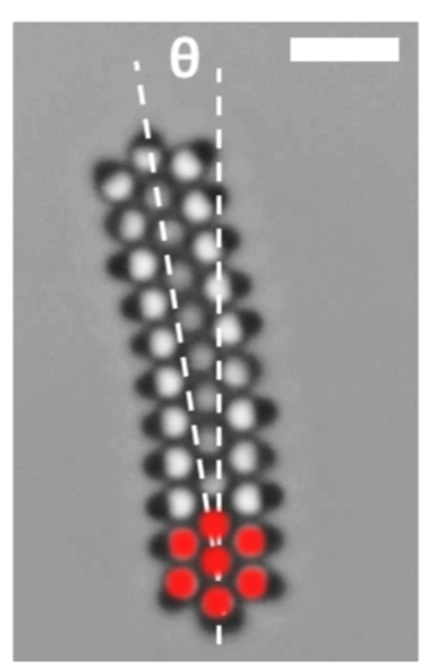
Signalling and cell-cycle coupling
Somitogenesis is probably the most famous developmental system with phase waves. We found the cell cycles to be coupled to the Hes cycles. What are the consequences?
Read more →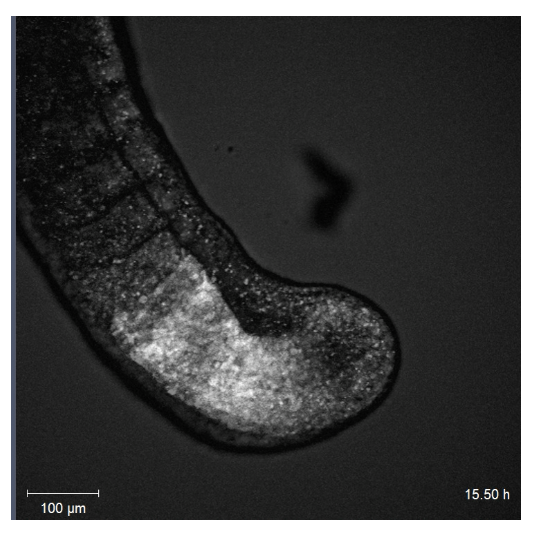
Self-organised phase waves
In mouse spermatogenesis, the sperm cells differentiate and mature over a long time (8.6 days). But from the mouse’s point of view, the animal would like to have sperm cells available at all times. We found that the sperm production happens in waves. What are the origin of these waves?
Read more →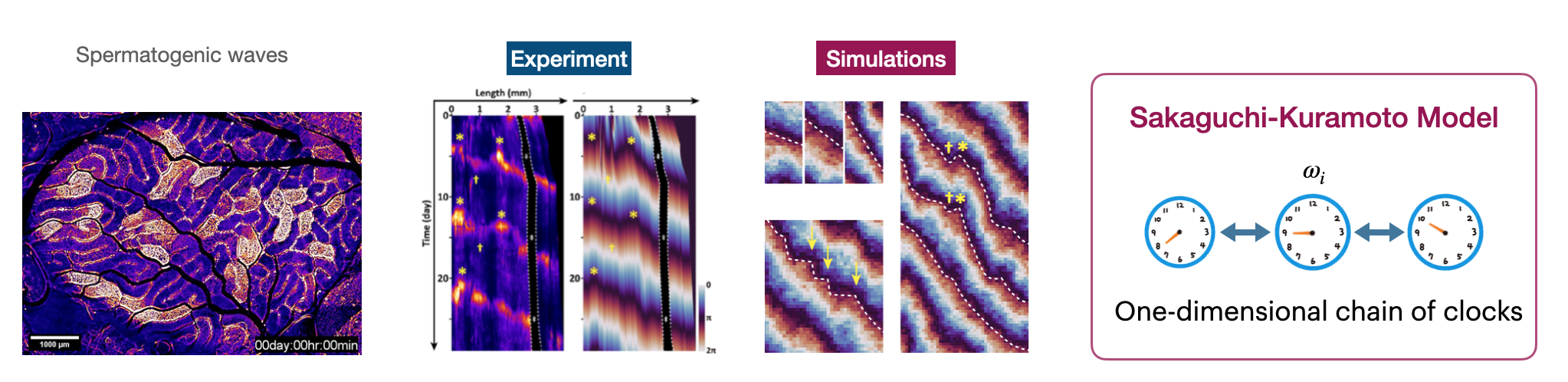
Liquid-state theory of active matter
Can the virial expansion of liquid-state theory be extended to active particles? We derive the coarse-grained density dynamics of self-propelled particles from first principles — with no equilibrium free-energy assumption — and recover the signatures of motility-induced phase separation.
Read more →
COVID-19 modelling
During the pandemic I worked on epidemiological modelling of COVID-19 as part of the Royal Society RAMP (Rapid Assistance in Modelling the Pandemic) initiative. We used a van Kampen expansion based inference scheme to improve speed and accuracy even when the population size is small.
Read more →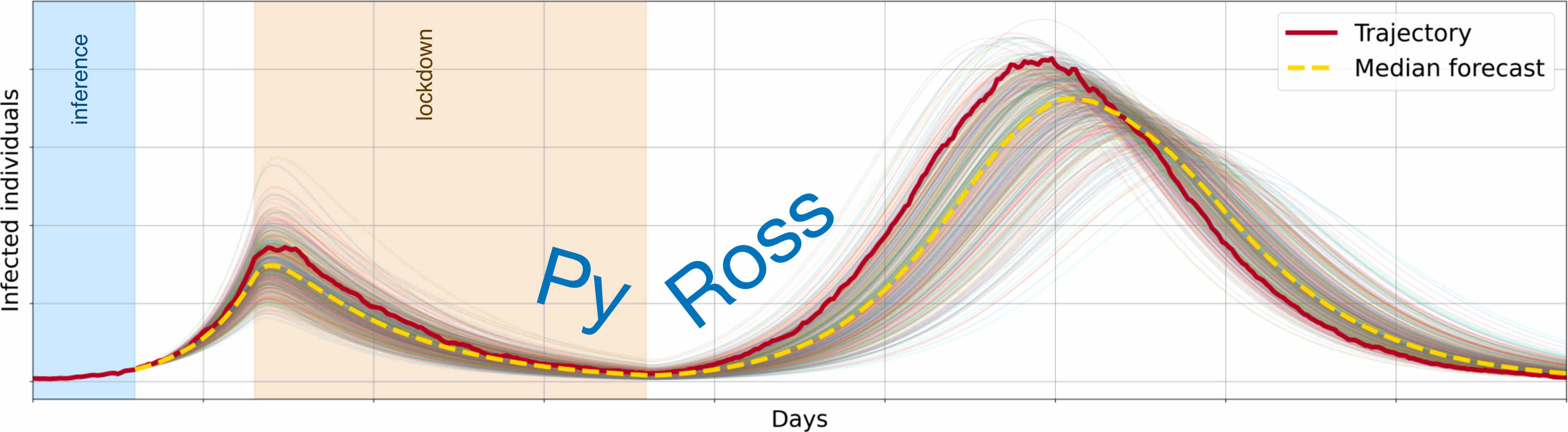
Model AB and its extensions
Model AB for phase-separating active systems with chemical reactions, where the conserved and non-conserved dynamics need not derive from a shared free energy, and its extensions to richer non-equilibrium behaviour.
Read more →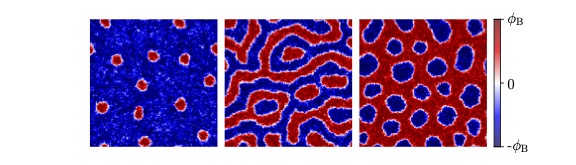
Entropy production of scalar Langevin systems
How much does a coarse-grained active field theory break time-reversal symmetry? We develop a general method to compute the entropy production rate of scalar Langevin field theories, together with a tractable small-noise expansion that we demonstrate on Model AB.
Read more →
Introduction to active matter
A popular-science introduction to active matter pitched at maths & physics undergraduates. Why should we be interested in this novel class of non-equilibrium systems?
Read more →