COVID-19 modelling
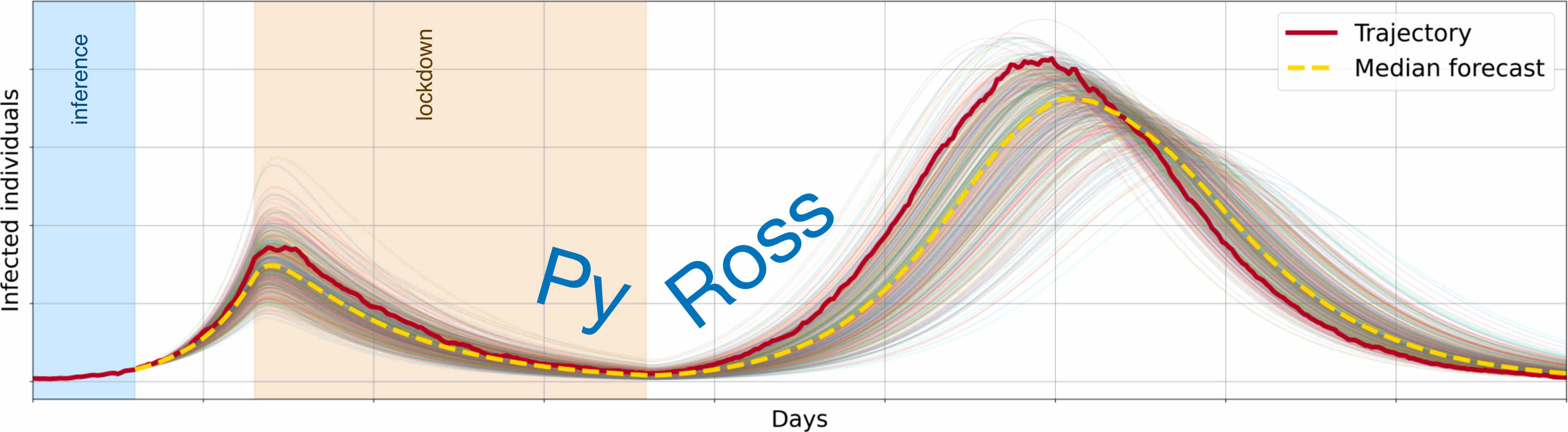
During the pandemic I worked on epidemiological modelling of COVID-19 as part of the Royal Society RAMP (Rapid Assistance in Modelling the Pandemic) initiative. We used a van Kampen expansion based inference scheme to improve speed and accuracy even when the population size is small.
With the Cambridge Soft Matter group, we developed PyRoss: an open-source Python library for inference, forecasts and optimal control of epidemiological models.
I headed the inference team that worked on estimating the `true’ parameters in our equations from publically available data. As far as we understood, a lot of infectious disease modelling is based on solving the SIR (susceptible-infected-recovered) equations as ODEs. A slightly more elaborate method adds multiplicative noise with amplitude $\propto$ total population. This is a common method to reduce poisson population process down to stochastic differential equation1, but the approximation is not well-controlled – there’s no small parameter that we are expanding with.
Thus, partly inspired by my PhD project2, we decided to base our inference scheme on van Kampen expansion, a controlled approximation with $1/$population as the small expansion parameter. The expansion reduces an extremely complex Poisson process to one ODE for the mean and one linear SDE for a small deviation from the mean, both of which can be solved numerically with ease. Thus, the method is a lot more efficient than the more accurate but computationally intensive Monte Carlo inference. Moreover, our method naturally deals with missing observations so not all variables need to be measured.
Combining the core inference method with Bayesian priors, and a separate forecasting module, we applied our scheme to COVID-19 using only death statistics in the UK.
-
See C. Gardiner’s book on Stochastic Methods. ↩
-
For my first PhD project, I wanted to combine the diffusion process with the birth-death process. This requires us to approximte the birth-death process, which is inherently Poisson, with Gaussian. And this is where van Kampen approximation comes in. ↩