Model AB and its extensions
Model AB for phase-separating active systems with chemical reactions, where the conserved and non-conserved dynamics need not derive from a shared free energy, and its extensions to richer non-equilibrium behaviour.
Model AB: a canonical model
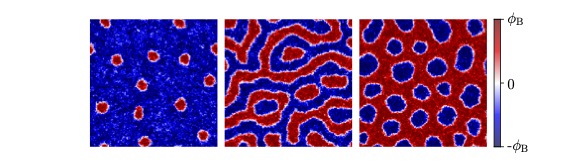
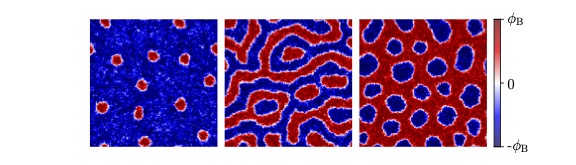
Active matter, characterised by its ability to inject energy into the environment locally, forms an important class of non-equilibrium systems. Recently there has been a surge of interest in active systems with chemical reactions, fuelled in particular by studies of biomolecular condensates, or “membraneless organelles”, within cells. In contrast to their passive counterparts, such systems have conserved and non-conserved dynamics that do not, in general, derive from a shared free energy. This mismatch breaks time-reversal symmetry (TRS) and leads to new types of dynamical competition that are absent in or near equilibrium. We construct a canonical scalar field theory to describe such systems, with conserved and non-conserved dynamics obeying Model B and Model A respectively (in the Hohenberg–Halperin classification), chosen such that the two free energies involved are incompatible. The resulting minimal model captures the various phenomenologies reported previously for more complicated models with the same physical ingredients, including microphase separation, limit cycles and droplet splitting. For further details, see my paper on Model AB.
Extending Model AB
To expand upon the systematic study of active reaction–diffusion systems, we also consider that the diffusive dynamics can break time-reversal symmetry in its own right. This happens only at higher order in the gradient expansion, but is the leading behaviour without reactions present. We incorporate the higher-gradient terms into Model AB and show that for slow reaction rates the system can undergo a new type of hierarchical microphase separation, which we call “bubbly microphase separation”. In this state, small droplets of one fluid are continuously created and absorbed into large droplets, whose length-scales are controlled by the competing reactive and diffusive dynamics. For further details, see my paper on Model AB+.
I also made a poster on this project: get the PDF