Signalling and cell-cycle coupling
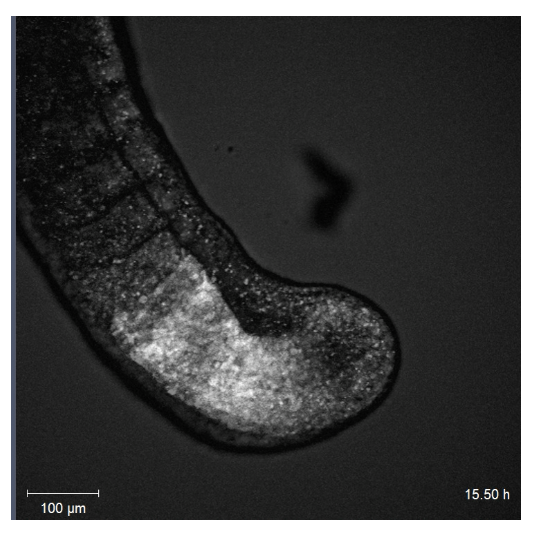
Somitogenesis is probably the most famous developmental system with phase waves. We found the cell cycles to be coupled to the Hes cycles. What are the consequences?
Somitogenesis is the process where our spins are made one segment at a time. During development, it requires the periodic segmentation of a continuously growing tissue. The timing and spacing of somitogenesis is regulated by the segmentation clock, which comprises of oscillatory Notch, Wnt and FGF signalling, as well as, FGF and Wnt morphogen gradients. The size of the somites scales with the size of the unsegmented region, called the presomitic mesoderm (PSM), over developmental time and upon experimental perturbation of PSM size.
Here, we addressed how scaling is ensured in the developing mouse embryo. We found that the entire length of the oscillating presomitic mesoderm is proliferating. Quantifying the dynamics of signalling and cell cycle progression in single cells, we detected a correlation between the two. Using a microfluidics-based entrainment approach, we showed that signalling oscillations and cell cycle are coupled, likely via periodic induction of S phase-inducing Cyclins.
An theoretical model incorporating this coupling suggests that this correlation ensures uniform PSM growth and uniform dilution of morphogen gradients by cell divisions, thereby directly affecting somite formation. Indeed, when blocking cell proliferation, gradient spreading and somite formation as well as somite scaling are impaired. Our data suggests a mechanism by which coupling signalling oscillations to cell proliferation ensures formation of properly sized somites and scaling of somite size.
Video credit: Ina Sonnen
See also: